Remember ME - You Me and Dementia

Showing posts with label Culture. Show all posts

Thursday, February 21, 2013

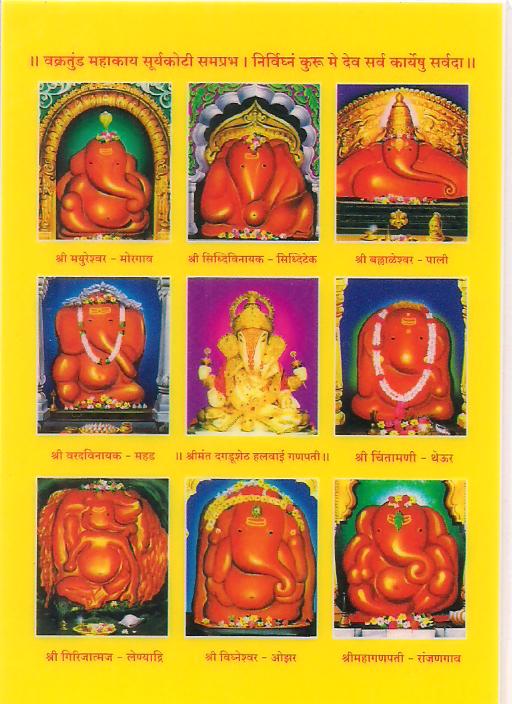
Spiritual Tour of Maharashtra, Ashtavinayak Yatra Feb 2013


This was my first spiritual tour of rural Maharashtra (Raigad , Pune & Ahmednagar district). Amazing and meaningful time spent with family and also learning more about our pilgrimage and people in rural area. 


We started early morning on 18th Feb from Mira Road, Mumbai and First place of our visit was MAHAD (Varad Vinayak); Second place we visited was PALI (Ballaleshwar); Third was Lenyadri (Girijatma) on the hill, nearly 300 steps; Fourth was Ozar (Vigneshwar). We had overnight halt at Ozar very good Accommodation at Temple Guest house no. 4, good rooms with attached toilet. 

Next day on 19th we again started early in morning and Visited RANJANGAON (Mahaganapati), then Sidhatek (Siddhi-Vinayak), then to Morgaon (Mayureshwar) and last at THEUR (Chintamani). We took night halt at Theur at Balaji Bhakta Niwas, good and reasonable accommodation. 

Mostly Ashtavinayaka Tour is a three days & two night visit, but we completed all eight temples in two days, though it was hectic travel. 

Ashtavinayaka literally means "eight Ganeshas" in Sanskrit. Ganesha is the Hindu deity of obstacles, unity, prosperity and learning. The term refers to eight Ganeshas. Ashtavinayaka yatra refers to a pilgrimage to the eight Hindu temples in Maharashtra state of India that house eight distinct idols of Ganesha, in a pre-ascertained sequence.

The Ashtavinayaka yatra or pilgrimage covers the eight ancient holy temples of Ganesha which are situated around Pune. Each of these temples has its own individual legend and history, as distinct from each other as the murtis in each temple. The form of each murti of Ganesha and His trunk are distinct from one another. However, there are other temples of eight Ganesha in various other parts of Maharashtra; the ones around Pune are better known than the former.

On last day i.e. 20th we started little late in morning at 8am and first visited Ramdara Temple near Loni, its is an old temple with idols of many deities. The main shrine is that of Shiva, but the statue is famous for the idols of Ram, Lakshman and Sita. Next to the temple is also an ashram of Shri Devipuri Maharaj also known as Dhundi baba. The temple also has am impressive Nandi. There is a small beautiful pond next to the temple. The location of the temple along with the abundance of trees in the vicinity makes this place very calm and beautiful.  Second we visited Shree Datta Mandir at Narayanpur, its only Ek Mukhi (signle head) temple of Lord Dattatray in India. Narayanpur is a famous place in Pune region.Narayanpur is famous for their Lord Ek Mukhi Datta.Usually lord Datta has 3 faces but in Narayanpur there is Ek Mukhi Datta.The statue of Lord Ek Mukhi Datta is very beautiful.The idol of Lord Dattatreya here in the sanctum is different from the idols that we see otherwise.You can also see the Padukas i.e. footwear of Lord Datta here. These were placed in the sanctum by Lord Datta himself before he left for Samadhi.Many devotees comes to Narayanpur on the eve of Guruvar and Pournima.The number goes in lacs on the occasion of Datta Jayanti.  

We also visited Ancient and beautiful Shiva Temple right next to the Datta temple known as Narayaneshwar Temple. The stone carvings inside the temple, the carved out ropes on the pillars remind you of the Kamakya Temple of Guwahati. The Shiva Linga in the sanctum is below the floor level which is the case in many Shiva Temples in India. The gabhara has gupta (hidden) Shiva-linga. Above it, there is golden shiva-linga gifted to the temple by Shivaji Maharaj’s mother Jijabai.  The burning lamp beside the Shiva Linga is the only source of light in the sanctum. 

Our Last visit of the Tour was Balaji Temple, Narayanpur. Balaji temple is replica of actual Tirupati Balaji Temple in Tirumala. The stone sculpture of the original Tirumala Tirupati temple has been mimicked in wood and painted in grey oil-paint here. The temple is an initiative by the Lord Venkateshwara Charitable and Religious Trust, a trust set up by the Venkateshwara Hatcheries corporate group. The standing idol of Balaji is royal and awesome. If you visit quite early in the morning, you can see idol of Balaji in a matter of minutes whereas on a weekend or in the later half of the day, you have to wait for hours in a long queue. Surrounding area around main temple has small temples of deities like Krishna, Mahalakshmi, and Padmawati etc. The temple is very well maintained and also provides living rooms and kitchen facilities for visiting devotees. We had our Lunch at Free Mahaprasadam, very tasty rice meal. Every one here gets Big Ladoo as prasad.

This Three days tour was wonderful, enriching and memorable; we reached home on 20th Feb late evening. Full of energy and peace to take on ongoing life.

For me it was recharging tour, away from maddening crowd and never ending work.
A well spend time with family and travel is good once in six months for life long happiness.  

Looking forward for more chance to explore my India ........  Sailesh Mishra 


Forget yourself for others, and others will never forget you.

Thursday, January 12, 2012

Bright minds and Dark Angels


Being a 5-pointer proves to be too much for these bright students and they fail to deal with the pressure.

Dad – sorry I couldn't be a better son to you… all you asked was my betterment of my career and future and I couldn't give it to you… I have failed you dad and I am so sorry about it. I cannot show my face to you
Mom – Sorry mom, I really did love you more than dad….

I was weak I thought I could become strong but I was weak, I was so so so weak the fault is my own. The fault is my own. Hope something good happens with my death. Firestallion has left the building…

I wish to donate my eyes and internal organs…. At least somebody can be benefitted with my death.
In another 2 min it will be 3:13 both my fav numbers. awesome time to die 

These were Nitin Kumar Reddy's last words in an email he sent to his father. The final-year M.Tech student at the Indian Institute of Technology Madras hanged himself from a ceiling fan in his hostel room after he got a semester extension.

Straight out of Raju Hirani's blockbuster 3 Idiots, Nitin aka Firestallion aka Swamy was on the verge of completing his final-year project, but could not meet the deadline. Unable to face the embarrassment of not graduating with his batch, he “left the building”.

'' I had told him not to worry; I would sort it out,'' says Nitin's father, Lakshmana Moorthy, who was to land in Chennai by the first flight the next morning. “I had left my office to attend a meeting. I got a call telling me that Nitin had sent a disturbing email. By the time my friend read out the email, he was gone.”

The pressure cooker description given by the media certainly does not go with the IIT Madras campus, located within a 620-acre natural forest with a magnificent lake and a wide range of flora and fauna.

However, in the last three years, the campus has witnessed six suicides—the highest number across IITs. This year eight IITians killed themselves across India, and IIT Madras leads this list, too, with two students, both from the mechanical engineering department, killing themselves.

In February, V. Anoop, 25, a final-year M.Tech student at IIT Madras, hanged himself in his hostel room, as he could not complete his course in time.

His father, Vijay Kumar, says Anoop had trouble with his guide, who “wasn't happy that Anoop did not consult him enough”. Anoop had requested a change, and it was granted. “His new guide had assured him that he would complete the project in time…. But we got a letter from the institute asking us to re-register. I got a call that midnight that he was gone,” he recalls.

And more recently, in September, B. Gowri Shankar, a second-year postgraduate student at IIT Madras was found dead in his room. It is suspected to be a case of suicide, though forensic experts are yet to confirm it.

According Nitin's friends, he had finished the major part of his project: simulation. “He had trouble fixing the engine,” they recall. “He asked his guide for help. He was told to approach the lab technicians, but they apparently were unable to help. Nitin tried fixing it himself, which did not happen. Finally on the day when he had to submit the thesis, the engine wasn't ready.”

And that meant Nitin had to repeat a semester. His plum placement plans bid him goodbye, and he bid goodbye to life.

Students who knew Nitin say he had initially faltered with his time-management. “His project guide should have noticed this and helped him fast-track his work,” says a student. “Indeed, many professors fail to pay enough attention to projects, as they are busy with researchers under them.”

While extensions pushed Anoop and Nitin to the extreme, the latest IITian to give up on life—Mehtab Ahmed, a first year student in IIT Kanpur—had been on campus just for a couple of months. The youngest in his family, Ahmed hanged himself from the ceiling fan in his hostel room on September 22.

The reasons being cited were many, including love affair and homesickness. The end result, however, was scrawled across the wall of his room in pencil: “I am tired of IIT-Kanpur.” This was the ninth suicide in IIT Kanpur in five years. 

Concerned about the spike in the number of students killing themselves, the IIT Council headed by Human Resource Development Minister Kapil Sibal has recommended setting up of a task force—consisting of teachers, parents and students—to study the issue.

Eight suicides across India in an annual combined batch of 10,000 might seem, as one professor in IIT Madras put it famously, “statistically unimportant''. But when the country's brightest students decide to end their lives, it does call for, if nothing, introspection.

Life@IIT

What makes these brilliant students crack? Boman Irani as the heartless professor may have been the chief reason for many students to give up in 3 Idiots, but in real life, it is much more complicated.

And it is not that IITs are like Nazi camps. Majority of the graduates say IIT was the best part of their lives. Even current students agree: “It is fun; the pressure is part of it,” says an IIT Madras B.Tech student. “We booze once in a while, we have ‘unofficial' inter-hostel competitions, and we have our own share of masti, besides plenty of sports and recreational facilities.”


Forget yourself for others, and others will never forget you.
Monday, August 8, 2011

After the Slutwalk


I’m sitting in London and the BBC is reporting that hundreds walked Delhi’s streets on July 31 to protest sexual harassment – although, it noted, there was “little of the skimpy dressing that has marked protests elsewhere” (http://www.bbc.co.uk/news/world-south-asia-14357443). They write: “Most of the marchers in Delhi were soberly dressed in jeans and T-shirts or traditional shalwar kameez.” (Someone tell the BBC that even jeans and T-shirts are controversial in India – especially when young women wear them, provoking calls to ban women from wearing jeans every few years.) This would have left Indian media rather disappointed, having spent considerable airtime and vocal energies in the last few weeks anticipating with rising excitement what girls participating in Delhi’s SLUTwalk would wear. It’s that word that has caused all this excitement and disappointment, the debate, the sermonising, the distancing, the embracing.  

I’m at first relieved that Delhi’s Slutwalk march (also called Besharmi Morcha in an attempt to localise the march) did take place after all without any scuffle from rightwing hoodlums. I’m impressed that 19- and 20-year-old women pulled off organising it and articulating their thoughts to a paparazzi-like media. While I’m not sure if there really were ‘‘hundreds’’ of people on the street (and if there were, I don’t doubt that half of them were media) but just the fact that young girls and boys, a common public, not attached to women’s groups or political parties, came out onto the streets on a Sunday morning to protest against sexual harassment of women is to me, a critical turn in sexual politics. 

The resistance to the word ‘slut’ though is more difficult to understand. So a police officer in Toronto said in January 2011 that ‘‘if women don’t want to be raped they shouldn’t dress like sluts’’. So what? It’s not new to Indian ears. Our rape law was born from one such judgment – the Mathura case in which a young girl was sexually assaulted by two policemen, but the court did not find the policemen guilty, saying that Mathura was ‘‘habituated to sexual intercourse’’. The judgment led to outrage from women’s organisations, which called on the government to reform rape laws, which it did in 1983. Many cases have followed in Mathura’s wake: all of them have shown us that the state machinery routinely attributes blame for violence against a woman to her ‘character’ or lack thereof – insinuating of course sexual impropriety – or in other words, ‘sluttiness’.

The central idea behind the Toronto police officer’s comments is therefore not new to us even if the word ‘slut’ is. Just as the Mathura judgment enraged women’s organisations here in the early-1980s, the police officer’s comments enraged a young generation of women who decided to march the streets in their skimpiest clothing, making the point that whatever women wear, they cannot be violated – that a woman’s clothing has nothing to do with rape or sexual harassment. Within months women mobilised to hold mass demonstrations from Toronto in April 2011 to Chicago in June 2011 and in between in smaller towns like Dallas, Asheville, Ottawa, Boston, Denver, Calgary. Fuelled by social media outrage and videos and ideas going viral in cyberspace, it quickly outgrew Canada, sliding into neighbouring USA and even crossing the shores to Delhi – demonstrating the resonance that such an idea has across cultures.  

Over the last month, the chatter around Delhi’s planned Slutwalk has been phenomenal. Five thousand people have associated themselves with their Facebook page and even bothered to write a comment and engage with the issue. I have read debates on a feminist listserve, watched in amazement a whole page of newspaper dailies devoted to the event and listened quite agog to the special debates on the issue on news channels. The usual grouses have been shared widely: that it is a Western import– which it is but so was Take Back The Night and the 16 Days of Activism that takes place every November; not about poor women – which is not a necessary condition for the validity of a protest march; culturally insensitive and contextually misplaced – an old grouse. Women young and old, but especially young, from around the country have analysed, discussed and critiqued various aspects of the chatter: the problems with the word ‘slut’; the politics of clothing; strange justifications as to why men sexually harass women and so on. The discourse just got wider, more populated with opinions and just turned into a dynamic landscape over the last few months. 

Will there be any more Sluttalking now that the Delhi Slutwalk is over? Who knows, but beyond the chatter, I think we missed talking much about the elephant in the room: women’s sexuality and how younger women today are expected to be somewhat ‘sexy’ if they want some social currency. In a recent research study I was part of which explored what middle class women experience online, the majority of young women explicitly stated the desire to represent themselves as ‘sexy’ in pictures they put up online, believing that it increased their social status amongst peers and raised their own self-esteem. Their own definition of ‘sexy’ was very broad and hardly controversial – anything from fitted jeans or a sleeveless top or even styled so that they looked like a movie star. 

It is complicated: we now have a bevy of cheerleaders in IPL (usually women who are conspicuously not Indian), advertisements and popular culture replete with sexual and sensual references (especially positive affirmations by women themselves – think Sheila, Munni and so on) but still dressing ‘slutty’ (which, the Indian media tell us, means wearing ‘‘fishnet stockings and micro minis’’), as the subtext of debates on Slutwalk tell us, is crossing cultural boundaries. We are still hypocritical about acknowledging women’s sexuality and how it is really all around us today, and in flux.  

To be fair though, I have met many sex workers and women in prostitution, and have never seen them wear anything more or less than any other poor, marginalised women. But perhaps we would also like to be able to dress ‘like sluts’. Or wear red lipstick. Or a flower in our hair, a shiny nosepin. Just on any day, not just our wedding day when it is legitimate for a young woman to acknowledge her sexuality without the fear of being raped or being assumed to be a slut. I’ve never worn fishnets and a micro mini on the streets but now I know I probably can’t because the discussion around Slutwalk has made it clear that certain boundaries cannot be transgressed.

The division between good women/bad women is one of the deepest divides amongst women. An initiative like Slutwalk strikes a feeble but important blow at this iron wall (at least the way it has manifested in the West). Women not only spend their lives trying not to get raped but also trying not to be called sluts. This is of course difficult given that it takes very little to be called one, especially in our context: this one laughs too loudly, this one smokes, this one drinks wine, this one comes home late from work, this one is a dancer, this one talks to boys, this one leaves her hair open, this one wears lipstick, this one wore a sleeveless blouse, this one wears jeans… you get my drift. 

In our case, we were still distancing ourselves from sluts, not only not- embracing the word, but also the concept. A Slutwalk won’t reduce the number of rapes or directly reduce the number of cases of harassment on the streets – for that we will need sustained political will, convictions, safer cities, public attitudes, embracing women in the public sphere and many other things. But that isn’t the point (perhaps the most repeated refrain by people defending the initiative). A few weeks ago a man bludgeoned his daughter (in fact, try Googling ‘man bludgeons daughter’ to realise the volume of cases out there) to death because she went to the mall with boys (http://articles.timesofindia.indiatimes.com). The point is what basic message the Slutwalk initiative gives out: in their website the Toronto organisers state that the reason for Slutwalk is ‘‘because we’ve had enough’’. 

Because, really, we have had enough.

Source: http://infochangeindia.org/women/third-wave/after-the-slutwalk.html

Forget yourself for others, and others will never forget you.

Friday, June 10, 2011

Why poor rural tribals will remain poor for generations


A new survey by the Chronic Poverty Research Centre identified 15 regions spread over six states where poverty is getting concentrated and chronic, and found that tribal and forested areas are likely to remain poor, with the decline in poverty among the rural tribal population going from 51.9% to just 47.3% .

  Poverty is becoming hereditary in India, at least for a sizeable population. That is the conclusion derived from a three-decade tracking of poor households in rural India.
A survey by the Chronic Poverty Research Centre (CPRC), an international association of researchers and academicians, claims that those who are chronically poor may pass on poverty to their next generation. What’s more, people residing in tribal and forested areas are likely to remain poor forever, fomenting violent conflicts in future. Most of India’s forested districts are already dens of Naxalites.

The survey, India Chronic Poverty Report, comes at a time when the country is awaiting its latest National Sample Survey for estimation of poverty. On April 21, while unveiling the approach paper to the 12th Five Year Plan for 2012-17, the Planning Commission disclosed that poverty has reduced from 37.2% in 2004-05 to 32% in 2009-10. The estimate is critical for the next Plan and the eagerly awaited and much debated National Food Security Law.

A controversy erupted the day the commission made the disclosure. The Supreme Court ordered the commission to explain how it fixed percentage of people below-poverty-line (BPL) at 36%. The percentage helps the commission decide the direction of development programmes and distribution of foodgrains under the public distribution system.

The apex court’s observation came in the wake of a petition filed by nonprofit People’s Union for Civil Liberties. The petitioner contends that adequate foodgrains are not being given to people living below the poverty line. This case is known as the Right to Food. The court also challenged the commission’s estimates of BPL families. “There cannot be two Indias,” said the apex court while describing the country’s high economic growth and consistent poverty. “The poverty level is reducing but at a slow pace,” says Biraj Patnaik, principal adviser to the court’s commissioners for the case.

Two Indias
The survey by CPRC explains the “two Indias”. “Why do some people remain poor for a longer period of time? Why do poor areas remain poor forever? These are the questions answered by the survey,” says Aasha Kapur Mehta, professor of economics at the Indian Institute of Public Administration in Delhi, who leads CPRC in India.

The survey followed about 3,000 households for almost 30 years across the country. It adopted a three-pronged approach to poverty: what drives poverty, what retains poverty and what causes exit from poverty.

CPRC has published 32 research papers in the past five years explaining various aspects of poverty in India. It defines the chronic poor as people who remain poor through their lifetime. Analysis of the papers shows that at least 50% of India’s poor are chronic poor. The survey identified 15 regions spread over six states where poverty is getting concentrated and chronic (see map). “Persistent backwardness and inequality have led to concentration of poverty in certain parts of India. So there is a geographical dimension to poverty,” says the CPRC report.

The count of very poor (with a consumption expenditure of Rs 9 per day per person) is an indicator of chronic poverty. Though the number of very poor is decreasing, the percentage is quite substantial. Their number was 115 million in 2004-05—37% of the total poor. The percentage of the very poor in the total population has declined in all states except Orissa, between 1983-94 and 2004-05. The percentage in Bihar, Madhya Pradesh, Maharashtra, Orissa, Tamil Nadu and Uttar Pradesh is higher than the all- India figure.

The share of Bihar, Madhya Pradesh, Maharashtra, Orissa and Uttar Pradesh in the total of very poor people rose from 57.5% in 1983 to 66.8% in 1993-94 and to 70.6% in 2004-05. “This is alarming because the next generation of these people will also be poor. Thus a vicious cycle is created,” says Mehta.

According to the survey, people in tribal and forested or degraded forest regions are more likely to remain poor forever. Nine of the 15 identified regions are forested; they have been targeted for poverty alleviation programmes since the early-1950s.

The report says, “In forest regions, the issues are not so much agronomic or natural conditions as poor people’s access to the resources that are there, their human capital endowment and the way they are incorporated into labour market.” The survey points out the poverty reduction among tribals is slow. Estimates for 1993-94 and 2004-05 indicate that against a decline in poverty for the entire population from about 37% to 27%, the decline among the rural tribal population was from 51.9% to 47.3%.

Amita Shah, director of Gujarat Institute of Development Research, says, “Poverty reduction programmes must include issues of economic growth, employment generation, socio-spatial equity, environmental sustainability and political stability within a holistic framework.”

Why poverty becomes chronic
According to the survey, there is inequality in the efforts made to prevent people from poverty and get them out of it. The numerous poverty alleviation programmes are inadequate and insufficient. Of the 29 such programmes studied in the survey, only nine could prevent people from falling into the poverty trap. Thirteen could enable escape from poverty and 16 could alleviate chronic poverty. Consequently, says Shashanka Bhide, a senior fellow of the National Council of Applied Economic Research, a significant proportion of non-poor households may fall into poverty while a large proportion of poor may not manage to escape it.

The report is a wake-up call. “Social conflict may find easy recruits among the chronically poor, who have less to lose by engaging in conflict and might be mobilised by the politics of grievance,” says the report. Anand Kumar, professor of sociology at Jawaharlal Nehru University in Delhi, says, “The report points to four major deficits the country is facing—development, legitimacy, governance and democracy. This created another crisis, time deficit.” He adds, “People are no longer willing to wait; there is a sense of urgency, suggesting the need for continued mass mobilisation and protests.” 

The full report is available http://www.chronicpoverty.org/publications/details/india-chronic-poverty-report
 
This article first appeared in Down to Earth, May 31, 2011. Richard Mahapatra is a senior environmental journalist presently with Down to Earth, and a former Infochange Media Fellow.


Forget yourself for others, and others will never forget you.

Tuesday, April 26, 2011

The lower odds for female births in India


India's 2011 census report has many heartening things to say. More educated men and women indicate a surge in literacy. People are living longer than ever before. Stability can be seen in the size of family; couples are having fewer children.

One exception to this hunky-dory picture is the steep fall in the number of girls. There are only 914 girls, 6 years old and under, for every 1,000 boys­ — not shocking if one considers that as many as 60,000 girls go missing every year. To use the word missing is a misnomer: The girls are killed often as soon as they are born in a society obsessed with boys. Many are aborted in the womb.

According to statistics, the sex ratio in India may be less slanted than it is in China. But while China's ratio has stabilized, India's is showing a disturbing trend. The gap between the number of boys and girls is widening alarmingly.

Social activist Sabu George, who has been working on gender issues for a quarter century, says that the murder of girls is nothing but "gendercide." More than 8 million girls have been killed in the last decade alone, pulling the sex ratio from 927 in 2001 to 914 in 2011.

"We will soon have the dubious distinction of being the nation eliminating the largest number of girls every year — along with being a place that has the largest number of starving children and the highest maternal mortality," George said. "In the coming decade, over 10 million girls will be killed if something is not done immediately to stop this massacre."

Although the government is well aware of the problem, it has done precious little to curb gendercide. And what is scary is that the economically well-off states like Punjab, Haryana and Gujarat have been in the forefront of murdering the girl child.

Equally frightening is a widely prevalent misconception that sex selection will check population explosion. However, the truth is something else. Of the 5 million fetuses aborted in the last decade, 3 million were girls and 2 million were boys. So, it was a clear case of going in for a sex determination test merely to have a boy. Limiting the size of the family appears to have been the second priority.

Unlike in China, where the one-child policy has been ruthlessly enforced by the dictatorial regime, India's democracy — except during the Emergency in the 1970s — has never involved coercing its population to go in for smaller families.

Of late, though, educated, elite Indians have been voluntarily having fewer children. They also have the money to get expensive scans done. If a couple already has a girl, they tend to get rid of the second child if the fetus happens to be a female. Sometimes, several female fetuses are aborted in this way.

In the impoverished regions of India and among the poor, the birth of a girl is not welcome. It is looked upon with not just trepidation but a sense of doom. To start with, girls cannot be married without huge dowries or bride prices, and they are of little use to their own parents once they leave home. Girls once married are hardly expected to take care of their parents. Boys do, and their brides could bring home dowries — an attractive proposition in a nation of 1.3 billion people where 75 percent live in abject or semi-abject poverty.

In the final analysis, such a warped sex ratio can have serious repercussions. Rape, for instance, tends to increase in a community that has an unusually large number of single men. Other social maladies also rise.

The 2003 Indian film "Motherland: A Nation Without Women" examined the impact of female feticide and female infanticide on the gender balance, and consequently on the stability and attitudes of society. Its plot bore some resemblance to real-life instances of gender imbalance and economics resulting in fraternal polyandry and bride-buying in some parts of India. The picture was grim and disturbing.

Yet, there is hope. With rising female literacy and employment, girls are not considered as burdensome as they once were. There is some societal reflection on the issue.

The government needs to encourage more girls to attend school and provide financial incentives to those willing to bear and nurture girl babies. State subsidies for their education may be an added motivation to cherish girls.


By Gautaman Bhaskaran ,a freelance journalist based in Chennai, India.


STOP KILLING GIRLS , LETS PROTECT THEM 
 

Forget yourself for others, and others will never forget you.

Monday, November 29, 2010

Mother, shall I put you to sleep? MERCY KILLINGS


We all need to STOP this uncivilized practice of killing our Elders , we need to STOP this ELDER ABUSE . This is violation of Human Right . WAKE UP AND RAISE YOUR VOICE !!!!!!!!!!!!!

THIS IS SHAME TO OUR CULTURE AND SO CALLED TRADITION.


Maariyamma is likely to be killed by her children because they cannot afford her. They will give her a loving oil bath. Several glasses of coconut water. A mouthful of mud. Perhaps a poison injection. She is just one of many old parents in Tamil Nadu dying in this way. But no one blinks at these ritual murders.

IN TAMIL, it is known as thalaikoothal. A leisurely oil bath. An exercise in love and health when given to newborn children, a ceremonial beginning to festivals, and the universal answer to pitiless summers. In Tamil Nadu’s small industry hub of Virudhunagar, however, it is the beginning of slow murder. The marker of the devastating poverty that makes a son kill his own aging mother.

Young family members of this district in southern Tamil Nadu have been pushing their infirm, elderly dependents to death because they cannot afford to take care of them. When 65-year-old Maariyamma suspected this might happen to her too, she moved out of her son’s house two years ago. “I’m not well enough to live on my own, but it is better than being killed by them,” she says. Amazingly, there is no bitterness in her voice. Or anger. “They’re struggling hard to take care of their own children,” says Maariyamma, of her sons. She places no blame. Her two sons and two daughters are farm labourers who travel to different villages every sowing and harvesting season. Seeing her children at pains to run their house, and feed and educate her grandchildren, Maariyamma knew she was a burden. She knew how it would end if she didn’t leave.

Maariyamma had seen it happen to other men and women of her age. Her neighbour, Parvathy, had been paralysed at the age of 76. “She had only one son,” says Maariyamma. “And he was working in Chennai, surviving on some menial job there. How could he afford to look after his bedridden mother?” One day, Maariyamma says, Parvathy’s son came, “did it” and went back to Chennai. “What else could he do?” she asks. Again, in place of anger or fear, there is helpless resignation. And a strange empathy for the person who might elaborately plan her murder

Thalaikoothal works thus: an extensive oil bath is given to an elderly person before the crack of dawn. The rest of the day, he or she is given several glasses of cold tender coconut water. Ironically, this is everything a mother would’ve told her child not do while taking an oil bath. “Tender coconut water taken in excess causes renal failure,” says Dr Ashok Kumar, a practicing physician in Madurai. By evening, the body temperature falls sharply. In a day or two, the old man or woman dies of high fever. This method is fail-proof “because the elderly often do not have the immunity to survive the sudden fever,” says Dr Kumar.

OVER THE years, other methods have evolved too. The most painful one is when mud dissolved in water is forced down; it causes indigestion and an undignified death. Velayudham of Help age India says the families often take the mud from their own land, if they have any. “It is believed that this makes their souls happy,” he says.

Dorairaj, a farmer in Satur, confesses that Muniammal, a distant relative, had been killed four months earlier. She was 78, and too weak to fend for herself. She was given an oil bath, but somehow survived. After a few days, she was given the ‘milk treatment’. “When the milk is being poured, the nose is held tight,” says Dorairaj. This ‘milk treatment’ is often preceded by starvation. The household stops serving the parent solid food. “When milk is poured uninterruptedly into the mouth, it goes into the respiratory track. A starving person cannot withstand even a moment’s suffocation,” says 60-year-old Paul Raj, coordinator of a district elders’ welfare association.

For those who choose poisoning as their modus operandi, Ganeshan is the man to call. This middle-aged man lives in Paramakkudy village, and introduces himself as a ‘medical practitioner’. In reality, he is Doctor Death. Ganeshan sources and administers lethal injections on demand. According to him, it is simply a service. “I am not killing anybody who may have a longer life. It is done only in the last and final stage of one’s life. Why should they suffer in poverty?” he justifies. Ganeshan defends his ‘profession’ but says he’d rather have some other means of livelihood. Azhagappan, a small shop owner, revealed that Ganeshan is not even a trained nurse. “He had worked in a hospital as the lowest grade attendant for a few months. That’s where he learned to give injections.” Azhagappan estimates that Ganeshan charges Rs. 300 to Rs. 3,000. Ganeshan refuses to disclose the chemical combination of his poison.

Though everyone seems to be in the know, thalaikoothal officially remained unexposed until the death of 60-year-old Selvaraj, of Ramasamipuram village in Virudhunagar on 18 June this year. Selvaraj, who was bed-ridden due to an accident, died suddenly. Asokan, Selvaraj’s nephew in Virudhunagar, raised the alarm on his uncle’s death. He registered an FIR, and subsequently a woman named Zeenath was arrested for administering a poisonous injection. Prabhakar, the Virudhunagar Commissioner of Police, admits that it is hard to find any evidence. “The body was cremated and there is no scope for a re-examination of the corpse,” he says.


Zeenath has been released on bail and refused to talk to TEHELKA when we met her in her village, Ramasamipuram. Some villagers claimed that Zeenath was a ‘professional mercy killer’.

A few days after Selvaraj’s death came to light, a newspaper published a report exposing more mysterious deaths in the district. When the district administration of Virudhunagar learnt how widespread the mercy killing was, it ordered an investigation. “It was shocking for all of us,” says V K Shanmugham, district collector in Virudhunagar. He soon realised that conventional state responses like arrests, warnings and interrogations would not even scratch the surface.

Thalaikoothal lay in the indefinable space between crime and desperate acts of poverty. It was social custom, a collective family decision, a ritual goodbye to a loved one who had lived a full life. Sometimes, it was the victim’s own idea. Shanmugham found that many called it a path to “eternal peace”, an escape from the violence of poverty. “It is difficult to view this simply in a legal or criminal framework,” he adds.

If thalaikoothal is seen as a crime, an entire village is accomplice. Community members and relatives not only support the practice, several even arrive a day before the auspicious oil bath to meet the aged parent one last time. Everybody knows the man or woman is going to die.

“Nobody questions or reports it to the police. They don’t even see it as a crime. It is a kind of accepted practice,” says Dr Lakshmi, a physician in Karyappetti village. Over 75, Dr Lakshmi recollects that she has been hearing of this practice of killing the elderly for 34 years.

The practice is not confined to a particular caste or community. “The poor do it, whatever their caste,” says Chandra Devi, the district Welfare Officer. Most residents are seasonal farm labourers, livestock shepherds or migrant workers in small factories in the nearby industrial hub Sivakasi. Their mobile lives make it virtually impossible for them to stay home to care for their parents.

Killing is indeed a brutal solution to financial burdens, but community members claim there is no alternative. “It does not mean that they do not love their parents,” says Chellathorai, the president of Paneerpetty village Panchayat.

Paul Raj, of the district elders welfare association, recently requested the district collector for government protection for the elderly. “The aged in these villages are highly vulnerable. We demand government’s immediate action.” Raj, however, realises that while police forces can protect an aged woman from her children, what they really need is protection from penury. “If the seniors had some income, they would not be considered so burdensome,” says Raj. “For example, if they got more pension, or at least got it regularly, it might give some respite.”

Kasi, a daily wager, moved out of his son’s house after his wife died. He’s not sure if he’s 65 or 70, but his shock of white hair, equally white handlebar moustache, and soil-black wrinkled skin are testament to his long and arduous life. Kasi had decided to leave when he watched his children grow tired of tending to their father’s every need. “I’m very fond of them, and can’t imagine they will try to kill me,” he says. “But anyway, I didn’t want to push them to any extreme step.” Whether he too would have been invited for that chilling oil bath some years down, Kasi doesn’t know. And he didn’t stick around to find out.

ACROSS VIRUDHUNAGAR, even as elderly men and women leave their homes, they make excuses for their children. “My son was struggling with his own life,” says Kasi. They put up a brave front. “I’m surviving fine with the ration rice at 2 per kilo,” says a reed-thin Maariyamma. They starve, and sigh, but do not complain. Thalaikoothal is to them not cowardly murder, but a brave farewell. Kasi and Maariyamma do not see how extreme it is, how dramatic. For them, it is a sort of practical love that is simply about survival.


BY SHAHINA KK shahina@tehelka.com


Source: Tehelka - India's Independent Weekly News Magazine

Forget yourself for others, and others will never forget you.

Wednesday, October 6, 2010

"A Petition to the President of India to SAVE Prehistoric Monolith Gilbert hill in Mumbai ,India"


I am a creative director and documentary maker, wildlife photographer and by nature a social activist. I am currently working on a documentary and Article with trustee(s) of Gilbert Hill to save this prehistoric Monolith. I started an online campaign to save our geological wonder. I thank you all for their incredible support. I shall not remind Government and bureaucrats. It is their sweet will. I only know that I am also a part of greedy system. I see the beauty and also the problem, over population, man's need for dwelling, poverty and greed for money. The one thing of many that is wrong in India is that very few people hold a lot of power. Gilbert Hill is certainly the best place in suburban Mumbai. It is the only hill of its kind in India and had been reportedly declared a National Park by the Central Government in 1952. The 200-foot-high vertical columns of the Gilbert hill are similar to the Devil’s Tower in Wyoming, USA. It was notified as a heritage Grade II structure in September 2007. Mumbai’s 65-million-year-old Gilbert Hill is threatened by a rash of urban constructions around the pre-historical monolith.

Gilbert hill should be preserved for future generation to enjoy and to appreciate. "Gilbert Hill is an eye sore. Let it be removed and replaced with a man made cesspool or a parking lot” .How do you like this approach? Common men think, there is nothing more, we can do. I am an ordinary Indian citizen. The change required is at smallest of effort done by ''me''.............it will change: every system does and we all have a power to do so; starting with me'. However there are more pressing problems that concern the health of the masses. But it is my Nobel Responsibility to save our natural heritage site. Some western people would shell out millions to visit such monument, but when it’s free for locals & matter of spending some Thousands for Rest of India.......no One's bothered. SHAME!!! I am awfully sorry if I seemed harsh it was in reaction to what I felt that we did ruin to our heritage. It will be great to have your support for campaign to save Gilbert Hill. I would also like to ask you a favour to ask people to sign a petition .Attached herewith are a copy of the article on Gilbert Hill along with picture. Kindly acknowledge.

A petition is hosted on the web ("Kindly ask the Indian president to save Mumbai’s 65 million year old Gilbert Hill”) at http://www.PetitionOnline.com/savehill
Kindly find Links of the media articles attached with this note. The article was published in The Times of India on Gilbert Hill on 13 September, 2010.

http://epaper.timesofindia.com/Repository/ml.asp?Ref=VE9JTS8yMDEwLzA5LzEzI0FyMDA2MDA=&Mode=HTML&Locale=english-skin-custom

http://epaper.timesofindia.com/Repository/ml.asp?Ref=VE9JTS8yMDEwLzA5LzEzI0FyMDA2MDI=&Mode=HTML&Locale=english-skin-custom

We need to get more voices to impress upon her the urgency of this issue. We will run the petition till Oct 10, 2010 and thereafter will submit the hard copy to the President.


Best Regards,
Shail Rane (Creative Director and Activist)
shailr78@yahoo.com


Forget yourself for others, and others will never forget you.