Remember ME - You Me and Dementia

Showing posts with label Travel. Show all posts

Thursday, February 21, 2013

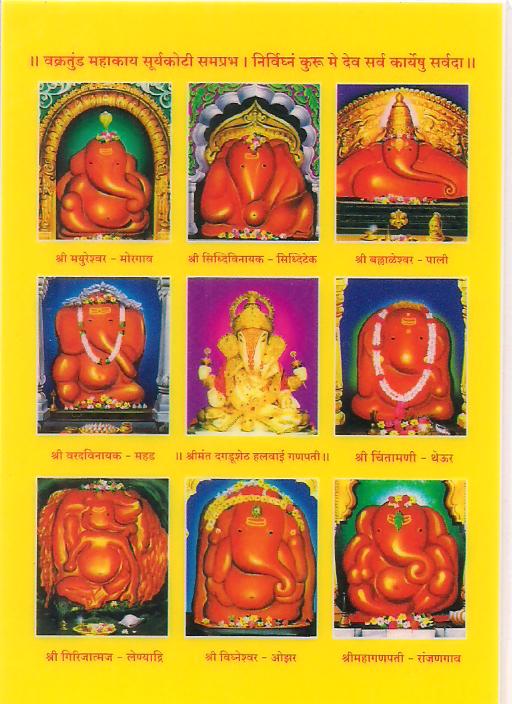
Spiritual Tour of Maharashtra, Ashtavinayak Yatra Feb 2013


This was my first spiritual tour of rural Maharashtra (Raigad , Pune & Ahmednagar district). Amazing and meaningful time spent with family and also learning more about our pilgrimage and people in rural area. 


We started early morning on 18th Feb from Mira Road, Mumbai and First place of our visit was MAHAD (Varad Vinayak); Second place we visited was PALI (Ballaleshwar); Third was Lenyadri (Girijatma) on the hill, nearly 300 steps; Fourth was Ozar (Vigneshwar). We had overnight halt at Ozar very good Accommodation at Temple Guest house no. 4, good rooms with attached toilet. 

Next day on 19th we again started early in morning and Visited RANJANGAON (Mahaganapati), then Sidhatek (Siddhi-Vinayak), then to Morgaon (Mayureshwar) and last at THEUR (Chintamani). We took night halt at Theur at Balaji Bhakta Niwas, good and reasonable accommodation. 

Mostly Ashtavinayaka Tour is a three days & two night visit, but we completed all eight temples in two days, though it was hectic travel. 

Ashtavinayaka literally means "eight Ganeshas" in Sanskrit. Ganesha is the Hindu deity of obstacles, unity, prosperity and learning. The term refers to eight Ganeshas. Ashtavinayaka yatra refers to a pilgrimage to the eight Hindu temples in Maharashtra state of India that house eight distinct idols of Ganesha, in a pre-ascertained sequence.

The Ashtavinayaka yatra or pilgrimage covers the eight ancient holy temples of Ganesha which are situated around Pune. Each of these temples has its own individual legend and history, as distinct from each other as the murtis in each temple. The form of each murti of Ganesha and His trunk are distinct from one another. However, there are other temples of eight Ganesha in various other parts of Maharashtra; the ones around Pune are better known than the former.

On last day i.e. 20th we started little late in morning at 8am and first visited Ramdara Temple near Loni, its is an old temple with idols of many deities. The main shrine is that of Shiva, but the statue is famous for the idols of Ram, Lakshman and Sita. Next to the temple is also an ashram of Shri Devipuri Maharaj also known as Dhundi baba. The temple also has am impressive Nandi. There is a small beautiful pond next to the temple. The location of the temple along with the abundance of trees in the vicinity makes this place very calm and beautiful.  Second we visited Shree Datta Mandir at Narayanpur, its only Ek Mukhi (signle head) temple of Lord Dattatray in India. Narayanpur is a famous place in Pune region.Narayanpur is famous for their Lord Ek Mukhi Datta.Usually lord Datta has 3 faces but in Narayanpur there is Ek Mukhi Datta.The statue of Lord Ek Mukhi Datta is very beautiful.The idol of Lord Dattatreya here in the sanctum is different from the idols that we see otherwise.You can also see the Padukas i.e. footwear of Lord Datta here. These were placed in the sanctum by Lord Datta himself before he left for Samadhi.Many devotees comes to Narayanpur on the eve of Guruvar and Pournima.The number goes in lacs on the occasion of Datta Jayanti.  

We also visited Ancient and beautiful Shiva Temple right next to the Datta temple known as Narayaneshwar Temple. The stone carvings inside the temple, the carved out ropes on the pillars remind you of the Kamakya Temple of Guwahati. The Shiva Linga in the sanctum is below the floor level which is the case in many Shiva Temples in India. The gabhara has gupta (hidden) Shiva-linga. Above it, there is golden shiva-linga gifted to the temple by Shivaji Maharaj’s mother Jijabai.  The burning lamp beside the Shiva Linga is the only source of light in the sanctum. 

Our Last visit of the Tour was Balaji Temple, Narayanpur. Balaji temple is replica of actual Tirupati Balaji Temple in Tirumala. The stone sculpture of the original Tirumala Tirupati temple has been mimicked in wood and painted in grey oil-paint here. The temple is an initiative by the Lord Venkateshwara Charitable and Religious Trust, a trust set up by the Venkateshwara Hatcheries corporate group. The standing idol of Balaji is royal and awesome. If you visit quite early in the morning, you can see idol of Balaji in a matter of minutes whereas on a weekend or in the later half of the day, you have to wait for hours in a long queue. Surrounding area around main temple has small temples of deities like Krishna, Mahalakshmi, and Padmawati etc. The temple is very well maintained and also provides living rooms and kitchen facilities for visiting devotees. We had our Lunch at Free Mahaprasadam, very tasty rice meal. Every one here gets Big Ladoo as prasad.

This Three days tour was wonderful, enriching and memorable; we reached home on 20th Feb late evening. Full of energy and peace to take on ongoing life.

For me it was recharging tour, away from maddening crowd and never ending work.
A well spend time with family and travel is good once in six months for life long happiness.  

Looking forward for more chance to explore my India ........  Sailesh Mishra 


Forget yourself for others, and others will never forget you.

Wednesday, July 1, 2009

The activistocracy


One day in January 2004, a group of excited schoolchildren from Mumbai entered a room at the WSF – the World Social Forum. The sign outside said ‘Rainbow Planet’ and their teacher vaguely hoped that it promised crayons, colouring books and world peace. Instead, this group of toddlers found themselves confronted by the love that once dared not speak its name; whereupon the teacher blushed and fled, dragging her curious wards with her.

It was a welcome jolt of levity in an otherwise excruciating exercise. Back then, as Mumbai girded its loins for WSF, I was agog with excitement. It was my very first, and I had been looking forward to it for months. It was also the only WSF I could afford to attend, being as it was in my own backyard. I came, I saw, I wanted to be conquered. But all I got was a lungful of dust.

When my sister and I arrived at the WSF, we had no idea that it would be spread over 65 acres of land, or that there would be 100,000 others of our kind. We asked if wheelchairs were available (my sister is physically disabled). After some hours of hanging around, it became apparent that they were not. My cousin found us seats in a van. We cut a swathe through the common people trudging to the main stage, discovering to our horror that we were in an ambulance equipped with a wailing siren and rotating lights.

It deposited us in the VIP section – a small patch of grass right in front of the stage, cordoned off by tight security, presumably, for the activistocracy to mingle uninhibitedly. And they did. Arundhati Roy had a flower in her hair. The folks who made up Junoon rolled in, all black jeans, long hair and lit cigarettes, every bit the Pakistani Sufi-rock band of the moment. The show got on its way.

Junoon’s performance was received ecstatically; their throaty rendition of ‘Sayonee’ was just the thing to connect 100,000 individuals itching for love and revolution. Culturally speaking, it was all downhill after that. There were lurid exhibitions of ancient culture, in line with that famous rule of international activism: any act of resistance must involve ethnic people singing and clapping and swaying their hips.

Once the WSF meetings formally began, however, I was grateful for any hipswaying that could tear me away from crucial debates between crypto-autonomists and anarcho-syndicalists or whatever – especially when it was from sexuality activists like the folks at Rainbow Planet. These folks took their fun seriously, thank God, disregarding the quaint ‘days of war/ nights of love’ protocol on offer. If there was a useful merging of the old left and the new left, it was primarily because of them.

And if there were useful conversations, it was not necessarily by design. Some of the best outcomes of the WSF had their start in shared coffees and casual conversations; in fact, this was exactly the case with a since celebrated dispute between the Swiss multinational Novartis and the Indian government. South Korean activists suggested to their Indian counterparts that there was a basis to mount a challenge on Gleevec, a patented cancer drug. (The case that ensued from the challenge, which was heard through the year 2007, would guarantee the availability of affordable medicines in India and the world over). But the organisers of the WSF would say that such chance encounters and unforeseeable outcomes are precisely the point of it all, and one has to give them that. The WSF is indeed design by non-design, and often, it even works.

These were the good bits.

At the plenary sessions, a mixture of bedlam and boredom prevailed. I’m not saying that it wasn’t sweet of Mary, Trevor, Joe, Gilberto and Mustafa to trek all the way to Mumbai; I just wish I could have heard what they had to say. In the front rows, respectable activists and dilettantes strained their ears to hear about ethical globalisation, post-apartheid Soweto, bad IMF, good Brazil and the situation in Palestine. All we got was ambient clutter and a few muffled squeaks.

I missed hearing Leila Khaled, the Palestinian activist and celebrity hijacker. Friends had been immensely moved by her talk, so I read her up, first in a weirdly reverential interview for a trade magazine called Aviation Security International, and then on the BBC. While she came across as extremely warm, I did wonder about her outrage at being coshed, back then in 1970, and waking up to find her companion dead (“I was furious, shouting and crying”) – given that they had been overpowered, after all, while trying to hijack a plane.

In the back rows, exclusively populated by the Indian proletariat, people wondered when the Tamil and Hindi translation they had been promised was going to start. When it became clear that it wasn’t going to happen, and that no one could hear anything anyway, they stretched out and sensibly fanned themselves to sleep.

It was a good thing that the masses got some rest. There was so much for them to do.

Every time a camera crew came by, the masses had to march and shout “Down down World Bank!” or, alternatively, “Down down Coca-Cola!” University-educated researchers analysed the plight of oppressed people at panels; oppressed people themselves provided something that was quaintly billed as ‘testimonial’. Meanwhile, fearless leaders were interviewed by equally fearless journalists in the air-conditioned media centre, which doubled up as a VIP clubhouse and offered e-mail access, gratis, to the chosen.

On the positive side, one of the nicest things about WSF Mumbai was that it was not MR – Mumbai Resistance – a sideshow that had fallen down across the road. The brainchild of some twisted little Stalinists, MR’s beef with the WSF was that it had been tricked into believing that class was not the only valid unit of social analysis, thereby inviting the revolution to be led astray by feminists, queer people, black people, caste warriors and what have you. MR broadcast its every indignant wheeze in a quasi-academic mouthpiece which had concluded, in an earlier scholarly investigation, that abstract art was a CIA plot to distract the masses.

Another nice thing about the WSF is that there is no Plan. And the funniest thing about there being no Plan is that it endlessly consternates the nice Washingtonians and their tropical satellites who constitute the internal critique. No liberal, especially one who is actually at the WSF, wants to be publicly against it. (The most curious thing about the WSF might be that Nobel prize-wining economists are its most curious participants). They try to look like they’re listening, all the while sighing inwardly, and one ends up feeling quite sorry for them.

But I digress. Who is the ideal WSF participant? She is a woman born and raised in an obscure rural part of any third world country, subjected to crushing poverty which forces her to migrate to the city. She gets a job on the shop floor, sewing buttons by day, decoding bootleg translations of Gramsci by night. Thus emboldened, she realises that power is simultaneously diffused and concentrated in Empire (the title of Hardt & Negri’s first bestselling book). Persevering on, and having left the shop floor to ‘organise’ she finds out that the answer to everything is Multitude (the title of their second bestselling book). Then, if she is both truly deserving and truly with-it, she lands a proper job with a proper international NGO, corresponds with Susan George on email and confers with SubcomandanteMarcos in remote mountain hideaways. Finally, to crown her ascent to the ne plus ultra of activism, she uses her official credit card to pre-order the next Hardt & Negri manual on Amazon.com.

Two years after WSF Mumbai, I bumped into an altogether different kind of WSF participant in Orange Farm, on the outer fringes of Johannesburg. I was at a celebration for International Women’s Day and George had been temporarily employed by the organisers. He fondly recalled his trip to Mumbai, a week’s stay at The President, a five-star deluxe hotel in the smartest part of town, and scratched his head over the alleged rape of a South African activist by a South African judge – a less than ideal fluid exchange that had dominated headlines in India at the time (the charge was subsequently withdrawn).

George was the kind of person who was grateful for any employment that came his way. He lived in a tin shack in a particularly desperate part of Orange Farm, and had been trying to get a regular job for years. I mentally tallied the cost of his WSF jaunt – about US$3000. I wondered how many meals, taxi-rides or medicines that kind of money would buy. And lest this question be too charged with plain old historical materialism, here’s another: would George have had any say in how that money was spent on him?

Perversely, I was reminded of a sentence I’d been hearing a lot lately. “Float like a butterfly, sting like a bee.” For a brief while this was the official motto of the Multitude, a message to its minions and minders alike; Muhammad Ali to the organised, Spinoza to the organiser. Certainly, it is the definitive WSF sound byte – a rousing combination of depth and clarity with an interpretive sweep to boot. Right at that moment though, as I stood confronted by George and the vast multiplicity of his situation, it sounded ridiculous.

Sure, I realise that instigating global revolution is a thankless career, and I won’t pretend I have a clue as to how to go about it myself. Some of my best friends attend the WSF, and I firmly believe that everyone is entitled to some sex and tourism with their development. I just don’t think that we should confuse the WSF for something that it isn’t.

There have been many WSFs since that time in Mumbai. A round of ‘polycentric’ meetings in 2006 that left participants somewhat confused, and the real thing in Nairobi in 2007, where the rampant class bias left everyone thoroughly disgusted. Last year was dedicated to ‘autonomous global actions’ (ie nothing very much, really) and this year the WSF returned home to Brazil. Incredibly, the movement shows no signs of backing down.

Soon enough, itinerant interventionists will confer in some salubrious location and declare that “another world is possible” – again. But as they wonder why their masses are not fully down with the floating and stinging programme, perhaps they’ll engage more equally with the loves and lives of the humans whose interests they so tenderly protect. And when that happens, if that happens, regardless of the outcome, at least one thing will be clear: another WSF is impossible.


By Achal Prabhala,a researcher and writer based in Bangalore.


Source:
http://infochangeindia.org/200906257801/Governance/Features/The-activistocracy.html


Forget yourself for others, and others will never forget you.
Friday, May 8, 2009

Rejuvenate yourself with Nature: A special Summer Camp for Senior Citizens

Silver Innings a Social Entrepreneur organization dedicated for the cause of Elderly, has organized one of its kind first time in India a 4 days & 3 night special summer camp for Senior Citizens who are 50+ on Thursday 28th May 2009 at Redstone Eco Center & Organic Farm, Panchgini, near Mahabaleshwar, India.

The Theme of this summer camp is Successful Ageing.

This is an initiative to give chance to elderly to Rejuvenate themselves, to make new friends and to explore nature. The camp is designed to enhance the camp experience for Senior Citizens.Para Medical staff and Doctor on Call Facility available.

Panchgini derives its name from the five hills in Sahyadri mountain range around it with Krishna River flowing alongside. Panchgani is about 285 km from Mumbai and 100km from Pune . It is situated at 1293meters (4242 feet). Its one of the most popular hill station in Maharashtra.

The activities includes – Yoga, Meditation, Nature Walk, Organic Farming, Talent Show, Bon Fire , visit to Local Market and many more interesting things.

Date of Camp:
28th May 2009 to 31st May 2009 (Thursday, Friday, Saturday and Sunday).Thursday 28th Morning Departure from Mumbai and Return to Mumbai on Sunday 31st late Eve.

Camp Site:
The Redstone Eco Center & Organic Farm
Bhose Village
Panchgani (near Mahabaleshwar)
Maharashtra
India : 412805

Cost:
Rs.4750/- per person Ex Mumbai (This includes Travel by Non AC Semi Luxury Bus/CAR, Vegetarian Diet Food specially planned by professional dietician and Activities)

Note:
Detail itinerary and programme will be provided after registration.

If you are 50 + or you want to gift your parents a holiday then contact for registration and application form:
Mr.Bhavesh Chheda: 09892612992
Mr. Sailesh Mishra: 09819819145
Email id: info@silverinnings.com

Last date for registration and payment Thursday 21st May 2009.

Golden opportunity to discover yourself through sustainable living and understanding ecological balance.

This programme is organized by Silver Innings in association with Silver Inning Foundation and The Redstone Eco Center & Organic Farm.


Silver Innings, A New Beginning……………………………….


Forget yourself for others, and others will never forget you.

Tuesday, December 9, 2008

Taj Mahal becomes disabled-friendly

People with disability will now be able to take a closer, more intimate look at the magnificent monument to love thanks to the construction of nine ramps at various points in the complex.

The luminous 17th century marble tribute to love built by Mughal emperor Shah Jahan in Agra is India’s most popular monument, attracting over 2.5 million visitors annually. But all these years, disabled visitors -- as many as 25 turn up at the Taj every day -- could only gaze at it from the entrance because nobody had taken their special needs into consideration.

Now, finally, the Archaeological Survey of India (ASI) has responded to the needs of physically challenged tourists by constructing nine ramps at various points in the complex. Besides this, a dozen wheelchairs will also be made available to enable the physically challenged to move easily and conveniently around the Taj grounds.

“As many as 25 physically challenged tourists visit the Taj daily. Now that people know that the Taj has become disabled-friendly, more such tourists are likely to visit the monument,” says Munazzar Ali, an ASI official at the Taj.


The Taj Mahal, which is listed among the seven wonders of the world, was visited by an estimated 2,048,120 domestic and 491,351 foreign tourists in 2006. “Foreign tourists usually come with their own motorised wheelchairs and freely move around without assistance. But domestic tourists use the wheelchairs provided by us. Nine ramps of different sizes and lengths have been constructed, the longest one being 48 feet,” Ali adds.

Because of the Taj, Agra is the country’s top tourist destination both for domestic and foreign visitors, according to the Ministry of Tourism’s annual publication India Tourism Statistics.

Agra is a relatively disabled-friendly city with facilities and opportunities for rehabilitation of both the mentally and physically challenged. While the government’s efforts have been largely confined to opening schools for the physically challenged and fixing job quotas in the public sector, the city’s NGOs and philanthropists have helped fill the gap.

Rita Agarwal’s TEARS, a school for people with disabilities founded almost two decades ago, provides help to parents of disabled children. The school for the blind at Soor Sarovar also helps disabled students acquire skills and an education.

Likewise, the government school in Vijay Nagar colony for the deaf and dumb has been imparting education to physically challenged children from poor families.

Social activist Mukesh Jain, who started up a health helpline, says: “There was a time when people with physical disabilities were looked down upon and often sidelined. But now society is becoming more open and tolerant. With expert help from specialists, many disabilities are better managed today.”

“The chief cause of the rising incidence of physical disability is road accidents. As the number of vehicles on our roads shoots up so too do the number of accidents,” says medical activist Sanjay Chaturvedi.

The new facilities for the disabled will add to the Taj and Agra’s popularity and accessibility in a country where it is extremely difficult to find public places, government or private, that provide easy accessibility to people with disabilities.

The routine denial of basic rights of the disabled all across the country -- whether it be access to buildings or priority access to safety routes during an emergency -- is cause for concern. Wasim, a visually impaired English translator working with the Samarthanam Trust for the Disabled in Bangalore says: “We do not have access to all the floors of public buildings. And rarely do we find a helping hand on our visits to public places.”

Frequent power cuts too make life extremely difficult for the disabled. P S Chandrashekar, a visually impaired sports person, says: “In case of a power break-down, the lifts do not work. Consequently, we have to take the stairs and the situation gets worse when there is nobody around to help us.”

Sanjeev Sheel, managing secretary of the Anchal Charitable Trust, says that in spite of the People with Disabilities (PWD) Act 1995 and schemes available for the disabled they are unable to avail of the facilities. “Government departments seem to have no knowledge of these schemes,” he says.


Source:
http://infochangeindia.org/200812047518/Disabilities/News/Taj-Mahal-becomes-disabled-friendly.html

Forget yourself for others, and others will never forget you.

Wednesday, July 23, 2008

Breaking the wall

A social scientist’s understanding of two countries that have misunderstood each other. As much intriguing as enlightening, Billions of Entrepreneurs: How China and India are Reshaping their Futures and Yours by Harvard Professor Tarun Khanna contrasts and compares the two Asian giants and how they have been taking on the world — amply supplemented by on-ground stories and anecdotes.

At a discussion based on the book, the author was joined by Kiran Mazumdar Shaw, Chairman and MD, Biocon and market strategist Rama Bijpurkar and an audience that included ex-diplomats and his students. Much research, travels and ‘shock’ have gone into the writing of the book which Amartya Sen had described as ‘fun to read’.

Khanna, who considers himself “strongly fortunate to have been educated in foreign institutions”, says the ‘shock’ came from the “lack of awareness about India and China in the West. That motivated me to tell the story in first person.”

A book of hope? “Very much so. Post-1962 conflict, India has been scared of China, which is an understandable emotion. As for China, India is irrelevant. Both the views are anachronistic. The book can hope to help China speak of India in a positive way. To shake both countries, it is an exploration, an optimistic look at things to come.”

Billions... could well be described a travelogue that delves deeply into the social, political and economic history of the tiger and the dragon. A look at entrepreneurship in both the countries. Khanna’s book is not bound to the cities. It goes into rural India as well as rural China. “We have lot of entrepreneurs in rural India, we need to actualise their self-potential,” he says. “I have visited NGOs in both the countries.

We have multiple points of contact. But we have to change mental models. There’s a need to harness positive energy.”

So how much of India does he know? “I grew up in India...” And how many subscribe to his views, “People don’t have to agree with it. But they need to know,” Khanna retorts.

By Anupama Ramakrishnan
Source: http://www.deccanherald.com/Content/Jul232008/metro-wed2008072280300.asp

Forget yourself for others, and others will never forget you.

Monday, July 14, 2008

Doorway to a New Life

When everything is taken away from us, we become grounded in reality very quickly. A sage was once asked why he was so happy, he responded, "I have nothing left to lose!" Being grounded in reality happens in that split second when we know all is lost; a moment before the car crash, a moment after the diagnosis.

The reality we then face is quite different from the daydreams of our everyday illusions. The fanciful images that we had previously projected into our idyllic lives melt away when we come face-to-face with certain disaster.

There is something we can learn here, because many times, the result of a traumatic experience is that we come out of it a changed person, and the changes are usually for the better. New vistas open up for us, and we find ourselves and our interests somehow strangely altered. We actually become happier.

There are times in our lives when we do things and don't know why, and although these things may appear foolish to our friends, we feel compelled to do them nonetheless. Sometimes these things involve letting go of something very dear to us, and we can hardly believe what we are doing. This can be a crushing experience, yet we do it. Just when things are going swimmingly, there is sometimes an underlying urge to cancel everything out.

In the East, a tradition exists where people pile all of their belongings into a boat, sail out to sea, and dump them every seven years. If one followed this tradition, think of how careful one might be in what one purchased! In addition, how aggressive would we be in making money? Maybe we would forget about money and do what we love for a change. That would certainly produce some happiness.

If our karma is good, however, so good that we are protected from disasters, we might need to become proactive in causing our own disasters—to help things along. Great men in the past have done just that; Christ lived as a homeless beggar; the Buddha left royalty behind to live in rags in the forest for six years, seeking and finding enlightenment. Foolishness? Perhaps, but who has affected the history of the world more than these two men have?

In essence, what the Buddha and Christ were saying is that until the bottom drops out of your life, you will continue to love your life. True happiness is that Reality we touch when all is lost. Money, love, family; these are all caught within the web of existence; and existence is nothing but stress compared to this Reality.

Existence has three characteristics, three laws of the universe, and they are that:
1) Everything changes.
2) Life is stress.
3) No "self" stands behind life.

Reality, on the other hand, has never been born, will never die, does not come from a previous condition, and has the characteristics of eternity and unchangingness.

The three characteristics of existence are unassailable, and while we remain caught in them, we can never be truly happy although we try to convince ourselves otherwise. Look into your own heart and see what is true. It is only when life is taken away for a brief moment, when we escape momentarily from existence and touch that reality that we cannot speak about, only then is true happiness possible.

The miracle is that just touching this reality for a brief moment is enough to change our experience of life into one of happiness. Everything that we think will make us happy, all that they tell us to accomplish, to be ambitious about, and to compete for, never does so for long. If none of this makes any sense to you, then you must continue seeking happiness in the things of the world.

If for some reason seeking happiness in the world does not work for you, in the long run, then there are things that you can do to ease yourself into a reality where happiness is assured. By easing yourself into this reality, you are not required to give things up in a violent fashion; they fall away by themselves.

If you ever become serious about real happiness, weary of temporary happiness slipping through your fingers time and again, then go after the missing element. The missing element is emptiness, and there is a good way, a gradual way, and a certain way to bring this element into your life. Emptiness is the doorway to a new life, and the doorway to emptiness is meditation.

By Col. Satish DewanDWARKA,
NEW DELHI
scdewan@gmail.com

Forget yourself for others, and others will never forget you.

Monday, July 7, 2008

Silver Innings : 5000+ and Growing Strong

Dear Friend,
We are extremely happy to inform you that your website
www.silverinnings.com has crossed 5000 visitor milestone in just 2 months !!!!!!!!!!!!!!!!!!!!!!!

Thanks to all of our supporters and well wishers and all the Elders out there.

This website is dedicated to our elders and their family members; it’s our way of honoring them for all they have done for their families, society and country. We at Silver Innings are committed to ensure that ageing becomes a positive, rewarding experience for all. Ageing gracefully is the way of life we promote.We wish to help elders and their family members to overcome the challenges of ageing and show them the way to live with dignity in their sliver years.

Due to impressive and huge response we have decided not to limit ourselves to only web based services but have taken initiative to established an full fledged NGO ''Silver Innings Foundation'', a dedicated organisation for senior citizens and their family members.The details of this will be given later.

We have also started some grass root level work in Mumbai,India:
Memory Camps
Elder Abuse Interactive Lecture Series for organisations
Basic Computer Education in association with Sterlite Foundation,Mumbai
Basic Counseling
Basic Home based services
Website Development and related services
Lecture series in association with HELP Library,Mumbai
Networking with like minded people and organisation
Programme like World Elder Abuse awareness Month

With your support and blessing we would be able to reach out and provided need based services to Senior Citizens and their family members all over India and would expand globally.

You can support us by becoming our Members ,choose membership plan:
Primary Individual Membership
, its Free: http://silverinnings.com/primary%20individual%20form.asp

Life time Membership and become Patron,PAID: http://www.silverinnings.com/docs/Paid%20membership%20Form.pdf

NGO & Trust Membership For 10 years Membership,PAID: http://www.blogger.com/

Corporate Membership for 10 year Membership,PAID: http://www.blogger.com/

If you are interested in advertisement : http://www.blogger.com/

Help us, to serve our Elders in much better way.


You don't stop laughing because you grow old.
You grow old because you stop laughing.
-- Michael Pritchard

Warm Regards,
Sailesh Mishra
Founder President - Silver Innings Foundation,A dedicated Organisation for Elders and their Family members


Forget yourself for others, and others will never forget you.

Thursday, June 12, 2008

Getting street smart

Street plays continue to make a valiant attempt to usher in social change with 'relevant theatre', says Ismat Tahseen

What is this life if, full of care, We have no time to stand and stare? —W. H. Davies,

Leisure Considering the fact that the Aarushi Talwar murder case had its ripples across the country, it was but natural that its impact has been felt on the roads as well. Literally. '

Theatre groups that focus on contemporary social issues have swiftly made plans to incorporate the tragic case — or at least references to it — in their social commentaries. And these plays serve to make the common man stop and think. In a city where the person next to you on that railway queue may not even have the time to cast a friendly nod towards you, leave alone stop to lend a helping hand, this attention is welcome.

Little plays that are enacted at railway stations, by the road side and at bus-stands, that are established modes of communication, seek to shock, amuse, delight… in effect make people think hard on issues that are close to their hearts.

While these plays may not have the trappings of lavish sets and props that a stage play begets, but they do have all the drama and impact nevertheless, prompting the bystander to stop, stand and stare. Says 40-year-old Manjul Bharadwaj, who formed Experimental Theatre Foundation (ETF) in 1992, “Acting, if without true worth, is useless. “ETF put up 3,650 street shows last year; they moved from suburb to suburb staging plays. Our play Mera Bachhpan on child labour was staged more than 12,000 times nationwide and due to it more than 50,000 child labourers across India were freed from labour; I guess it ushered in a revolution,” he says with a tinge of pride.

Nothing beats the aura of being on the street, he reiterates. “Technology might be growing in leaps and bounds, but it cannot compare to the face-to-face interaction you have with others. It’s like a one on one with each person in the audience, one that impacts social change,” he adds.

Street plays can be seen in the most unexpected places – behind the vegetable stalls in your market place or at the bus stop – a group of people, acting out a short skit or play, for any one who might wish to stop and watch. “We’re not just philanthropists providing free entertainment,” says Mujeeb Khan, founder and director of Indian Drama and Entertainment Academy (IDEA). From a 15-minute street play on the tragic story of slain model Jessica Lal called Justice for Jessica, to plays on Zaheera Sheikh, Bilkis Bano and monthly plays on divorce and drama staged outside the Bandra family court, IDEA aims to reach out to the aam junta to create greater awareness about social issues, calling them to change what they believe are the social ailments.

“We won’t let any issue rest,” says Khan. “Halla Bol, our play based on the BMC’s plan to clean the city, was also well-appreciated.“ Street play artists also have to keep abreast of current affairs. “We distribute newspaper clippings to the public to convey our message more strongly.”

The only problem that these artists seem to have is a space to stage the play. “We should have dedicated places like Hyde Park in London,” Khan says. “Very often at railway stations the police come and stop the play saying the premises are under the Central Government jurisdiction,” Khan says. Notwithstanding these hiccups, the IDEA group has a few more plays up its sleeve.

Source: http://www.dnaindia.com/report.asp?newsid=1170485&pageid=0

Forget yourself for others, and others will never forget you.

Sunday, May 4, 2008

Travelling to teach programme launched

A new programme for teachers wanting to help underprivileged children over the summer holiday has been launched by a gap year company.

GapGuru specialises in travel to India and is looking for 20 inspirational teachers from the UK to spend three weeks teaching in India.

The 'Travelling to Teach' trip is scheduled to run from August 9th to 29th and GapGuru hopes it will give teachers a chance to make a difference to children in some of the most deprived areas of the country.

"We work with a number of charity schools, which provide education to children from some of the poorest backgrounds across India and they need our help and support," explained managing director Arvind Malhotra.

The programme is looking for qualified English language teachers and those with an aptitude for drama, arts and crafts, music or sport.

They will work with local teachers in schools, running a programme designed to help the children.

The three week trip costs £600, including a pre-arranged school placement, transfers, accommodation, meals, and in-country support from GapGuru's team of local coordinators.

For more information and to apply see the website or call 0800 032 33 50. Applications close on May 31st 2008.

Source: http://www.travelbite.co.uk/news/asia/india/travelling-teach-programme-launched-$1220771.htm

Forget yourself for others, and others will never forget you.

Wednesday, April 30, 2008

Being the Change: In Gandhi's Footsteps


After trying for years to achieve social change through mainstream institutional activism, I have turned to an approach deeply rooted in my own culture and history. I have spent the past nine years trying to understand how to live my values today rather than waiting for the system to change. My search for the roots of deep transformation have led me to re-engage with the seemingly mundane, the small, the slow, the inefficient, the unorganized, the invisible.

I became involved in activism in college. I focused on stopping discrimination against marginalized groups. I thought we could make the system work by reforming it to give equal rights to all. We signed petitions, held protests, issued policy reports. But despite minor gains, I felt we were losing our dignity, being made into beggars. I started to learn that the price for “redistributed benefits” to people in North America was being paid by people and nature in so-called Third World countries.

After college, I spent eight years in the belly of the beast—Wall Street, Harvard, the United Nations, NGOs—seeking to change the system from within. But I discovered that the problem was bigger than just removing a few bad apples or making some clever policy declarations. I started to question the labels we use, such as “under-developed,” “poor,” or “illiterate”; the manic logic of unlimited growth and obscene profits over all other values; and the reliance on experts and technocratic solutions, rather than on the people.

During this time I came across Hind Swaraj, a booklet written by Mahatma Gandhi in 1909. In it, he explores the nature of India's freedom struggle. He says, “It is not about getting rid of the tiger [the British] and keeping the tiger's nature [tools, systems, worldview, etc].” He calls for swaraj (rule over the individual and collective self) and urges us to look beyond “modern” colonizing systems of health, justice, and technology. I learned that non-violent political strategies require tremendous self-discipline and the courage to challenge our own comfort zones.

Gandhi's insights helped me transcend such false polarizations as capitalism vs. communism, Left vs. Right, and East vs. West. I found the courage to move beyond playing “big” power games to fix the state and market systems which, no matter how clever they were, only fueled the monster.

I started to reorient myself to a practice of honestly questioning my own complicity, fear, and insecurity, as well as searching for my own real sources of organic power. I resigned from UNESCO and moved back to India. I have been experimenting with hands-on alternatives—from self-healing to community media to urban organic farming—which reduce dependence on institutions and revalue physical labor as an essential part of intellectual growth, political activism, and spirituality. Much of my own unlearning has resulted from our family decision not to send our daughter to school.

I have met people from around the world who are working to regenerate their communities—many of whom do not call themselves activists and would never think of doing so. One is my “illiterate” grandmother, who is one of the greatest environmentalists I have ever known. She is not a member of Greenpeace, nor an environmental scientist. But she is an amazing up-cycler, taking responsibility for her own waste by finding new uses for everything from mango pits and peels to old toothbrushes. She cares for the people, creatures, and place around her, giving concrete meaning to “localization” and “zero waste” living.

For me, the most exciting change movements seek to re-legitimize and reconnect to the knowledge, imagination, and wisdom of traditional communities. Giving top priority to regenerating diverse local languages, ways of seeing, and systems of natural learning is urgent if we are to co-create our way out of the massive crises that face us today. Equally important is finding the courage to walk out of institutions and structures that reinforce violence, injustice, and exploitation. Through an active practice of non-cooperation, we can withdraw the legitimacy that they have in our minds and open up spaces of calmness from which to explore new possibilities.

It is critical that we search for real expressions of our nature, not the tiger's. Only then can we reclaim the dignity of our lives on our own terms.

By Manish Jain

Source: http://www.yesmagazine.org/article.asp?ID=2101&utm_source=ed0408&utm_medium=email&utm_campaign=25_Jain


Forget yourself for others, and others will never forget you.

Thursday, April 10, 2008

Activist proposes separate ministry for senior citizens; launches comprehensive website:Silver Innings


Mumbai, April 10, 2008: Renowned Right to Information (RTI) activist Shailesh Gandhi today inaugurated Silver Innings, a comprehensive and dedicated website to address the concerns of senior citizens, at a function held in Mumbai.

"This is a historic event for senior citizens," said Mr John Thattil, Regional Director (West), Help Age India, who was the guest of honour at the function. "Silver Innings is a new beginning for our elders, as it harnesses the modern, powerful medium of the Internet to help them not only to keep pace with the world, but also to network with each other and bind them together on an unprecedented scale," he said.

Highlighting the growing percentages of senior citizens due to better health care facilities and the increased life span, Thattil revealed that while senior citizens constituted 7.5 per cent of the total population in 2001, by 2050 the number is expected to rise to about 20 per cent. "There is a severe crunch of services for senior citizens and we need to start building them up right now," said Sailesh Mishra.

"This website is complementary to the RTI movement in that it is a one stop destination for all information related to senior citizens, a prominent disadvantaged group," said Mr Gandhi. "We have seen that information invariably leads to empowerment and Silver Innings, by ensuring that relevant and comprehensive information reaches the senior citizens through the modern digital, interactive media, will make life so much easier for them."

The website is a brain child of Sailesh Mishra, founder member, Silver Innings, who has extensive experience as an activist for senior citizens and other social causes. "We at Silver Innings are committed to ensure that ageing becomes a positive, rewarding experience for all, by helping them to overcome the challenges of ageing and show them the way to live with dignity in their sliver years," he said.

Mishra observes that while there is no dearth of NGO’s working for cause of women, children, education, and AIDS abound, there are few organisation dedicated to the concerns of senior citizens, and those too are concentrated in large cities like Mumbai, Delhi and Bangalore.


"It is for this reason that we wish to eventually develop this website into an NGO dedicated to senior citizens, as this cause is largely a neglected one" says Mishra. "Just as there are independent ministries for women, children and youth and national commissions for women, population and minorities, we now need a separate ministry or an independent state minister for senior citizens," he proposes.

Silver Innings is an initiative by four youngsters: Sailesh Mishra from Mira Road, Hendi Lingiah from Paris, Prof Parul Kilbilwala from Kandivali and Swati from Chembur, who have come together for a common cause.

"Information available in the public domain on elders is incomplete and not updated. There are many website’s for seniors, but most of them are being run by organisations and provide info on service provided by themselves. But there are hardly any website that gives objective and comprehensive information on the issues and problems of elders. This is the gap that Silver Innings fills in, like a super market where you get everything under a single roof," says Mishra.

This website will host sections on health and medical issues, finance and investments, law, leisure activities and hobbies, help line and counseling services and a directory of old age homes and other services needed by the elder population and their family members.

Sailesh says Silver Inning is silver line (ray of hope) in dark cloud and a new beginning for our Elders.

As part of their objective promoting Elder Cause, Silver Innings facilitated The Family welfare Agency, Mumbai for their grass root level work for the Elderly in Mumbai’s five wards.
About John Thattil – Guest of Honour
John Thattil, Regional Director (West) - Help Age India, A secular, not-for-profit organization set up in 1978, and since then have been raising resources to protect the rights of India’s elderly and provide relief to them through various interventions.

About Shailesh Gandhi – Chief Guest
An IIT graduate and career engineer, now Renowned RTI Activist, Social Crusader, He is also the ex-chairman of the IIT Bombay Alumni Association and continues to be a member of the IIT Bombay Alumni Board.

About Sailesh Mishra
Founder, Silver Innings. He left his corporate job of Fifteen years for Social Sector and now passionately involved in Elder Care for more the Three years.


Vital Statistics – Elder Population
Aged as per 2001 Census 7, 66, 22,321: 7.5% of Total population

Aged Male 37,768,327: 7.1% of total population

Aged Female 38,853,994: 7.8% of total population

General population in Rural 72.2% People in Urban 27.8%

According to UN urban population in India will increase from 30 % in 2010 to more than 50 % by 2045.

Projected Elderly Population in 2008 @ average 7.5% will be 8, 60, 75, 775
According to UN by 2050, nearly 20% of India’s population will comprise of people over the age of 60 years


Elder Population in Maharashtra as on 2001
Total Population: 96,878,627
Male: 50,400,596
Female: 46,478,031
Population of above 60 yrs. at National Average of 7.5%: 72, 65,897


According to UNICEF Life expectancy in India
In 1970 49 yrs
In 1990 58 yrs
In 2005 64 yrs
In 2008 68 yrs

According to UN Global life expectancy at birth, which is estimated to have risen from 46 years in 1950-1955 to 65 years in 2000-2005, is expected to keep on rising to reach 75 years in 2045-2050.

In developed countries, 20 per cent of today’s population is aged 60 years or over, and by 2050 that proportion is projected to be 32 per cent. And by 2050 there will be two elderly persons for every child.

According to World Life Expectancy.Com as on 2008 Global Life Expectancy:
India 68.6
USA 78
Australia 80.6
South Africa 42.5
China 72.9
Russia 65.9
Saudi Arabia 75.9
UK 78.8
France 80.6


www.silverinnings.com

Forget yourself for others, and others will never forget you.

Friday, March 28, 2008

How to get Business Visa to India

Hi, there is an request from one blogger with regards to Business Visa to India,so Iam giving below a write up and links where the procedure is given for the same.

Foreign Nationals desirous of coming into India are required to possess a valid passport of their country and a valid Indian Visa.

There is no provision of 'Visa on Arrival' in India and no fee is charged for immigration facilities at the airports. Foreign passengers should ensure that they are in possession of valid Indian Visa before they start their journey to India except nationals of Nepal and Bhutan who do not require visa to enter India and nationals of Maldives who do not require visa for entry in India for a period up to 90 days (a separate Visa regime exists for diplomatic/official passport holders).

The Consular Passport and Visa (CPV) Division of the Ministry of External Affairs is responsible for issuance of Indian visas to the foreign nationals for their visit for various purposes. This facility is granted through various Indian missions abroad.

Visa fees are non-refundable and subject to change without notice. The High Commission reserves the right on granting and deciding type/duration of visa irrespective of the fees tendered at the time of making application. Granting of Visa does not confer the right of entry to India and is subject to the discretion of the Immigration Authorities.

Specific Visas are granted for a variety of purposes. Listed below are the types of visa; categorised on the basis of purpose of staying in India:


Tourist Visa: 6 months stay, Docs supporting the applicant’s financial standing

Business Visa: One or more years stay, Document required: Letter from the sponsoring organisation

Student Visa: For the duration of the academic course of study or for a period of five years whichever is less, Document required: Proof of admission to recognized Universities/Institutions in India

Transit Visa: Maximum For 15 Days stay, Document required: Evidence of onward travel to a destination outside India

Conference Visa: For the duration of the conference or seminar, Document required: Letter of invitation from the organiser of the conference


Important links for Visa to India:
http://india.gov.in/overseas/passport.php

http://www.moia.gov.in/showsublink.asp?sublinkid=488

http://www.visatoindia.com/


Forget yourself for others, and others will never forget you.

Sunday, February 24, 2008

People are opting to go on a philanthropic trip

Celebrities like Richard Gere, Ashley Judd, and Angelina Jolie are role models for millions for their cinematic exploits and the styles they espouse. There is, however, something more that their fans and even ardent travelers can take inspiration from. Call it ‘voluntourism’, ‘philanthropic travel’ or vacationing with a purpose.

Adding a whole new dimension to the experience of globetrotting, this is an impeccable combination of voluntary services with the best elements of travel — arts, culture, geography, and history. From students to working professionals, top business executives to retired workers; travelers world over are increasingly choosing India as the destination for a voluntour.

And why not? India has all that a voluntourist might be looking for. It is home to exceedingly interesting and diverse ways of life which is lived by many an impoverished people who need all the help that they can get. Says Kiran Modi, trustee, Udyan Care, a Delhi based NGO, “There is a rise in the number of enquiries from people who want to come here to volunteer for community work because it gives them a fair chance to explore the rich culture and heritage.”

Vacationers, who seek a deeper level of interaction with local culture rather than just visiting museums and monuments, are seeing voluntourism as an appealing option.

“Volunteers who come to us feel that such tour provides more enjoyable experiences along with providing more meaningful connection with local people, and a greater understanding of local culture, social and environmental issues,” adds Siddharth Sanyal, who runs Dakshinayan, a volunteer based organization.

There are several non-profit organizations, tour operators and even volunteering agencies that help arranging a voluntour. Experienz Travels and iVolunteer Services are agencies most actively engaged in getting voluntourists to India. There are travel companies like Monarch International Travel Services, India-e-style Travel that have special volunteer tour packages. Also, Relief Riders International (RRI) has partnered with India’s Ministry of Tourism to contribute towards community development.

Tourists can volunteer for varied services like taking English classes for children; education on medical care and nutrition, physical and mental health; conducting workshops say for making artificial jewellery, etc. Some even volunteer to work on farms and fields.

While almost 65% of the voluntourists are students who come for university projects, 35 % are well established in their career. “Only recently we had a woman from US Army, Monica Colts who stayed for 3 weeks,” quips Saurabh Sabharwal, director Experienz Travels.

Experienz Travels started operations in India three years ago. “In the first year we had just about 70 volunteers. This year the number increased to 300 including students as well as working professionals,” informs director, Saurabh Sabharwal. “We intermediate between the tourists and NGOs like Child Survival India, Vatsalaya Foundation, Salaam Baalak Trust and Udayan Care,” he adds.

The itinerary and cost depends on whether the tourist wants to devote most of the time traveling or working. Most tourists work during the weekdays and visit places around on weekends. “We design a separate programme for volunteers depending on the kind of time they can spare and the kind of skills they have,” says Kiran Modi.
“We charge around $650 for two weeks but that depends on the choice of accommodation, local transportation, and food and also travel insurance,” says Saurabh.

Voluntourism has been criticized on the grounds that tourists opt for such kinds of tours since they are cheaper and do not take volunteering seriously. Mohammad Jamal from iVolunteer Service, however, argues that even if the tourists do not contribute much to community work they do get an insight to village life and the issues people face.

“There are people who come back and work for the community,” he says. For a traveller driven by a sense of purpose, voluntourism is fast becoming a wonderful way to explore another country, meet new people, learn new things and have new adventures.

Source: http://economictimes.indiatimes.com/As_You_Like_It/People_are_opting_to_go_on_a_philanthropic_trip/articleshow/2808716.cms


Forget yourself for others, and others will never forget you.

At 80 It’s wanderlust for me


Meeting Dorothy Conlon is a revelation. The spry 80-year-old puts a person half her age to shame with her energy and vivacity. And just hearing her talk about her travels makes you feel like a staid homebody. Ask her how she started on her trips and she laughs. “I think I was born with the travel bug running in my veins. I was born in Japan where my parents were missionaries and went back to the U.S. only when I was seven.”

Since no one was going to let a child her age take off alone, she had to finish school and college without much wandering. Then she joined the Foreign Service. “I was never career minded,” she confides. “But I thought this would be the best way to see the world.” A posting in Taiwan led to marriage with Ned and she quit her job. “In those days,” she sighs, “they wouldn’t allow couples in the same service; so I quit.”

On the move

It didn’t matter because now she went travelling with her husband. For the next 30 years, Dorothy wandered through Taiwan, Hong Kong, Singapore, Indonesia, Pakistan and India. “But always cocooned in the Foreign Service.”

After Ned’s death in 1989, Dorothy’s first trip was to Bangkok where she volunteered to teach. While she didn’t have much trouble, it wasn’t very satisfactory. “I didn’t really get to mix with the people,” she muses. “Bangkok is huge and the other teachers were commuting more than an hour a day; so once the classes were over, they were off trying to get home. And I lived a few minutes walk away. No, that wasn’t very nice, except for the teaching.”

But a year in Hanoi was more fun. “These were a bunch of scientists and they were trying to learn English because they knew they’d need to write papers and give presentations … stuff like that. And it was little groups of six or seven people. They’d take me to their homes, take me around, show me the sights… that trip gave me an insight into the culture and how people live.”

Curious mixture

Her trips were a curious mixture of touristy stuff and volunteer work. She has volunteered with Earth Watch and Global Volunteers, Global Service Corps. The package tours that she did take were “not the five-star la-di-dah tours that don’t show you anything,” she raises her shoulders and looks down her nose in an imitation of tourist snobbery. “If you’re going to a new place, take the local transport, walk around and get to see the sights… not through the window of an air-conditioned bus or car.” Her Earth Watch volunteer work led her to a programme studying the Indian wolf in Kutch, Gujarat; to a programme working for the conservation of cheetahs in Namibia; to a study of echidnas in Kangaroo Island, Australia.

“Except for the programme in Namibia, we didn’t really get to mix with the locals,” she says wistfully. “But the Cheetah conservation programme really showed us what the man-animal conflict was all about. The farmers there believe that the cheetah attacks their livestock and so they kill it. The CCF is working to educate them to better agricultural practices, to put their livestock in sheds at night. They’re also breeding a kind of guard dog, which they sell to these farmers. They’ve made a lot of progress, to the extent that now farmers call the CCF if they sight a cheetah instead of just working to kill it.”

South America is another area that she’s been exploring. Not Peru, “all the Americans go there. So I went to Bolivia.” And got caught in the midst of a miner’s strike. “Well, it wasn’t as dangerous as we thought it was,” she laughs. “They were blocking the roads; so we had to get off the bus and hike till we got another bus. We were about 20 hours off schedule but no, not very dangerous.”

Reactions

What about reactions from friends and relatives? “Oh, people hear that I travel and they ask, ‘where in Europe have you been?’ As if there is nowhere else,” she raps the table to emphasise her point. “And the whole world is just waiting,” she flings out her arms as if to embrace the world. “I go to places that have colour. I need colour in my life,” she smoothes down her colourful jacket and points to the multi-coloured birds dangling from her ears.


At Home in the World is Dorothy’s account of her adventures. Her editor Sarah Seidmann chips in, “With most people, you have to tell them to stop writing and then chop away. With Dorothy, I had to keep telling her to give me more material to work with. She’s very reticent.” Dorothy smiles, “I just knew I was meant to spend my life travelling. I only hope more people realise that you can get out and see the world before it’s too late.”

Source: http://www.hindu.com/mag/2008/02/24/stories/2008022450150500.htm

Forget yourself for others, and others will never forget you.

Sunday, February 17, 2008

Sorry Unable to post

Dear All,
As Iam travelling to Kochi Iam unable to post.

Its very hot and humid in Kochi,I felt worse then Mumbai.Its my first visit to this part of country - to God's own country Kerala.I think I have come at wrong time of the year.

Here there is so much green,hope all the city's have same green all over,but then Kerala is still untouched by construction boom,which has eaten away all the green parks/trees.God save us from this.

Let there be many many trees/ green cover,lakes and mountain around us.I love nature and feel bad we the human being have spoilt what God gave us,he wont be happy at what we did to his earth.

Oh lord save our soul!!!!!!!!!!!!!!!!!!!!!!!!!!!!!!!!!


I will be back by 19th and will start posting.

Thanks and Take Care.

Sailesh Mishra.


Forget yourself for others, and others will never forget you.

Monday, February 4, 2008

Interesting Facts about India: Mera Bharat Mahan

India is the world's largest, oldest, continuous civilization.

India never invaded any country in her last 10000 years of history.

India is the world's largest democracy.

Varanasi, also known as Benares, was called "the ancient city" when Lord Buddha visited it in 500 B.C.E, and is the oldest, continuously inhabited city in the world today.

India invented the Number System. Zero was invented by Aryabhatta.

The World's first university was established in Takshashila in 700BC. More than 10,500 students from all over the world studied more than 60 subjects. The University of Nalanda built in the 4th century BC was one of the greatest achievements of ancient India in the field of education.

Sanskrit is the mother of all the European languages. Sanskrit is the most suitable language for computer software - a report in Forbes magazine, July 1987.

Ayurveda is the earliest school of medicine known to humans. Charaka, the father of medicine consolidated Ayurveda 2500 years ago. Today Ayurveda is fast regaining its rightful place in our civilization.

The art of Navigation was born in the river Sindhu 6000 years ago. The very word Navigation is derived from the Sanskrit word NAVGATIH. The word navy is also derived from Sanskrit 'Nou'.

Bhaskaracharya calculated the time taken by the earth to orbit the sun hundreds of years before the astronomer Smart. Time taken by earth to orbit the sun: (5th century) 365.258756484 days.

The value of pi was first calculated by Budhayana, and he explained the concept of what is known as the Pythagorean Theorem. He discovered this in the 6th century long before the European mathematicians.

Algebra, trigonometry and calculus came from India. Quadratic equations were by Sridharacharya in the 11th century. The largest numbers the Greeks and the Romans used were 106 whereas Hindus used numbers as big as 10**53(10 to the power of 53) with specific names as early as 5000 BCE during the Vedic period. Even today, the largest used number is Tera 10**12(10 to the power of 12).

The earliest reservoir and dam for irrigation was built in Saurashtra.

Chess (Shataranja or AshtaPada) was invented in India.

Sushruta is the father of surgery. 2600 years ago he and health scientists of his time conducted complicated surgeries like cesareans, cataract, artificial limbs, fractures, urinary stones and even plastic surgery and brain surgery. Usage of anesthesia was well known in ancient India. Over 125 surgical equipment were used. Deep knowledge of anatomy, physiology, etiology, embryology, digestion, metabolism, genetics and immunity is also found in many texts.

The four religions born in India, Hinduism, Buddhism, Jainism, and Sikhism, are followed by 25% of the world's population.

The place value system, the decimal system was developed in India in 100 BC.
India is one of the few countries in the World, which gained independence without violence.

India has the second largest pool of Scientists and Engineers in the World.

India is the largest English speaking nation in the world.

India is the only country other than US and Japan, to have built a super computer indigenously.


I love India !!!!!!!!!!!!!!!!!!!!!!!

Forget yourself for others, and others will never forget you.

Tuesday, November 20, 2007

Weeklong Pushkar fair begins


The weeklong fair in Pushkar began today with a colourful display of Rajasthan's rural heritage.
The Rajasthan tourism department, which is organising the fair, has launched various schemes to attract a large number of domestic and international tourists to this annual event that has gained a worldwide recognition for being one of the largest cattle fairs of the country.

The state government has recognised over a dozen villages in the region where tourists will be taken to and allowed to stay there, as part of exclusive rural tour packages.Many modern events and games like para-sailing, rock climbing are also being organised in this rural fair for tourists, many of who come here to spend their vacation.

However, Pushkar primarily remains a pilgrim spot for devout Hindus, who flock in large numbers here to take a dip in the town's holy lake, especially during the Kartik purnima week.

Pushkar is the only place in the world where a temple is dedicated to the Hindu mythological God Brahma. According to the Hindu mythology (Padma Purana) Brahma was trying to find a place in earth where he could a special sacrifice when the lotus fell from his hand.

When the lotus touched the soil of Pushkar, water gushed out thereby forming a lake.The faithful turns out in large number here every year to take a holy dip in Pushkar's famous lake.

This time security has been tightened in the wake of recent blast in nearby Ajmer and a three-tier security arrangement is in place. Many security check posts have been erected and a large contingent of police and security personnel are keeping a close-eye there. Luggage scanners have been placed at various points leading to the fair and visitors are being frisked thoroughly.

The highlight of the fair is the mass camel trading followed by their race. During evening the State tourism department organises cultural shows that include songs, dance, performances of acrobatic skills and puppetry.

Visitors can savour large varieties of ethnic Rajasthani cuisines here as food courts have been erected at various places.This year around 3.5 lakh visitors are expected to throng the fair.

Source: ANI

Forget yourself for others, and others will never forget you.

Wednesday, November 14, 2007

WORLD TRAVEL MART 2007- INDIA MAKES ITS PRESENCE FELT

The World Travel Market in London is one of the largest tourism trade fairs in the world. The 2007 edition of this fair is being held at the Excel convention center from 12th November to 15th November. Over 5500 exhibitors from 202 countries and regions of the world are participating in this fair which will be attended by over 45000 travel trade professionals. Over the past 13 years, the World Travel Market has become an established business platform hosting debates, presentations, seminars, workshops and networking events for development and promotion of responsible tourism.

India is one of the largest participants at WTM with over 750 square meters of space at a prime location. The Indian travel industry under the aegis of the Ministry of Tourism, Government of India is well represented. Over 91 travel trade organizations including various state governments/ union territories, hotel chains, tour operators, airlines and specialist companies are participating in the Incredible India pavilion. More than 300 professionals comprising of the crème de la crème of the travel and tourism industry of India are promoting their specific destinations and products. Apart from this around 24 other organizations are exhibiting independently covering an additional area of around 500 sq meter.

The Incredible India pavilion sports a different look this year with the theme being the world heritage site of Ajanta. The traditional wooden pillars give the stand the look and feel of an ancient temple. The huge cloth banners depicting the Ajanta paintings are a definite attraction for the visitors. Coming inside the pavilion the visitors can meet with the travel trade from India at their individual booths and discuss business opportunities.

The Incredible India pavilion was inaugurated by Shri Shilabhadra Banerjee, Secretary to the Government of India, Ministry of Tourism in the presence of Shri Kamalesh Sharma, High Commission of India to the UK with the cutting of the ribbon and lighting the lamp. The tourism ministers of the states of Kerala, Jammu & Kashmir, Meghalaya, Pondicherry, Mrs Leena Nandan, Joint Secretary (Tourism), Government of India as well as other dignitaries were also present. This was followed by the formal release of the Incredible India fact finder published by Indiatourism London. Traditional Indian sweets and savouries were distributed to all present.


Source : http://pib.nic.in/release/release.asp?relid=32614

Forget yourself for others, and others will never forget you.